nHA vs Hydroxyapatite: What’s the Difference?
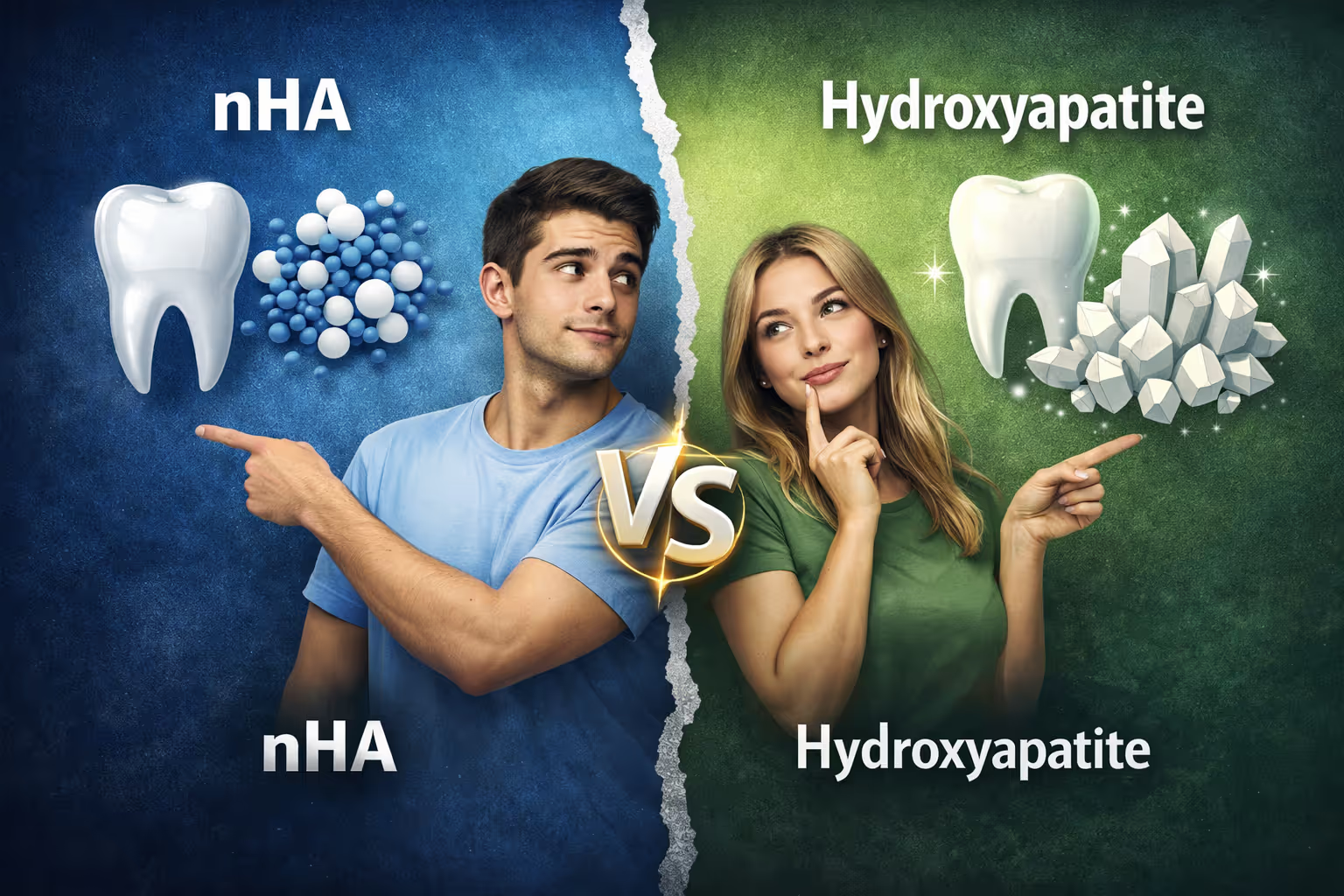
Walk into the oral care aisle and you might notice both ‘hydroxyapatite’ and ‘nano-hydroxyapatite’ appearing on toothpaste labels. They sound similar, and they’re made of the same mineral — but the difference between them is significant enough to determine whether a toothpaste actually works.
What Is Hydroxyapatite?
Hydroxyapatite (HA) is a calcium phosphate mineral with the chemical formula Ca₁₀(PO₄)₆(OH)₂. It is the primary mineral component of tooth enamel (97%), dentin (70%), and bone (60–70%). In its pure form, it’s a white crystalline solid. As a toothpaste ingredient, it can be derived synthetically (lab-produced) or from natural sources (historically bovine bone, though synthetic is now the standard for cosmetic use).
Hydroxyapatite has been used in dentistry for decades — primarily in bone grafts and dental implant coatings — because of its exceptional biocompatibility. As a toothpaste ingredient, it was first used in Japan in the 1980s under the brand Apagard.
What Makes It ‘Nano’?
The prefix ‘nano’ refers to particle size. A nanometer is one billionth of a meter — approximately 10,000 times smaller than the width of a human hair. Nano-hydroxyapatite (nHA) particles fall in the range of 20 to 100 nanometers in diameter.
By contrast, conventional or microcrystalline hydroxyapatite particles are in the range of 1 to 10 micrometers (1,000–10,000 nanometers) — orders of magnitude larger.
Why Size Determines Efficacy
The pores and micro-lesions left in enamel by acid demineralization are themselves nanoscale — typically 10 to 100 nm in diameter. This is the crucial insight: only nHA particles are small enough to physically enter these lesions and integrate into the enamel structure.
Larger HA particles, regardless of their concentration in a toothpaste, cannot penetrate into enamel pores. They may coat the enamel surface temporarily, providing some surface smoothing and minor whitening benefit, but they do not achieve the same depth of remineralization or tubule occlusion that nHA delivers.
“The remineralization potential of hydroxyapatite is scale-dependent. Nano-scale particles are not just smaller — they are functionally different.”
Synthetic vs. Natural HA
Modern nHA used in toothpaste is almost exclusively synthetically produced through a precipitation reaction of calcium and phosphate salts. This ensures consistent particle size, purity, and performance. Bovine-derived HA (from cow bone) was historically used but has largely been phased out in cosmetic formulations due to ethical concerns and inconsistent particle sizing. If you see a toothpaste marketed as containing ‘bovine hydroxyapatite,’ this is typically microcrystalline, not nano.
What Concentrations Work?
Research supports nHA concentrations of 5–10% as the effective therapeutic range for toothpaste. Below 5%, you may see limited benefit. Above 10%, studies have not demonstrated additional advantage, and the EU SCCS has set 10% as the approved maximum for consumer products.
Products using regular (micro) HA at these concentrations provide surface benefits but lack the enamel-penetrating remineralization of nHA.
How to Read Labels
Toothpaste labels in different regions use different naming conventions, which can be confusing:
- ‘Nano-hydroxyapatite’ or ‘nano-HAP’: The real thing. Look for this on the ingredient list.
- ‘Hydroxyapatite’ alone: Could be micro or nano — check if the brand specifies particle size, or look for a concentration of 5–10%.
- ‘Calcium hydroxylapatite’: An alternative INCI name for the same compound — check particle size claims.
- ‘Synthetic fluorapatite’: A different compound entirely, and should not be confused with nHA.
The Bottom Line
Not all hydroxyapatite is created equal. The ‘nano’ distinction is not a marketing label — it reflects a genuine functional difference rooted in physics and biology. When shopping for an HA toothpaste, look specifically for nano-hydroxyapatite at 5–10% concentration to ensure you’re getting a product with real clinical evidence behind it.
Ready to upgrade to a truly clean toothpaste?