How 20–100 nm Particles Repair Enamel (Explained)
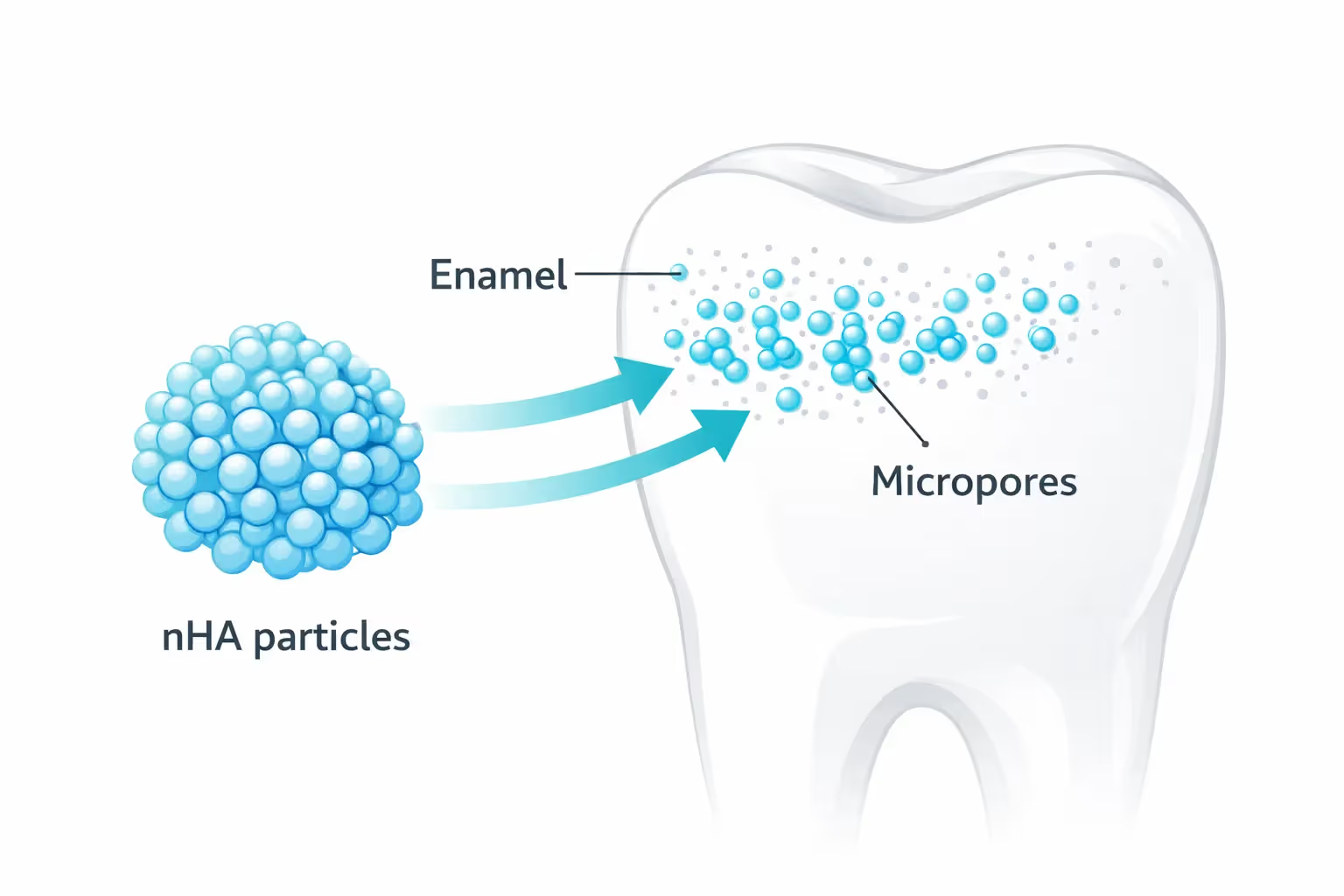
Your tooth enamel is the hardest substance your body produces. But despite its toughness, it has a critical weakness: once it’s gone, your body can’t grow it back. That’s what makes nano-hydroxyapatite (nHA) so remarkable — it offers something enamel itself cannot do: self-repair from the outside.
What Enamel Is Actually Made Of
Tooth enamel is approximately 97% hydroxyapatite — a crystalline calcium phosphate mineral arranged in tightly packed rods called enamel prisms. These prisms run perpendicular to the tooth surface and give enamel its characteristic hardness and translucency. The remaining 3% is water and organic proteins that help bind the structure together.
When acid attacks enamel — whether from dietary sources, bacteria, or gastric reflux — it dissolves the calcium and phosphate ions on the surface, leaving behind microscopic pores and soft spots known as early caries lesions or ‘white spots.’ This process is called demineralization.
Why Particle Size Matters: 20–100 nm
Here’s where the ‘nano’ in nano-hydroxyapatite becomes critical. The pores left behind by demineralization are themselves nanoscale — typically between 10 and 100 nanometers in diameter. Conventional hydroxyapatite particles, which are microscale, are simply too large to enter these pores.
Nano-hydroxyapatite particles sized at 20–100 nm are small enough to physically penetrate these pores and lodge within the enamel structure. Once inside, they act as mineral seeds, attracting free calcium and phosphate ions from saliva to build new hydroxyapatite crystals around them. The result is a restored, mineralized surface that is structurally continuous with the underlying enamel.
“Nano-hydroxyapatite doesn’t just coat the surface of enamel — it integrates into it. That’s a fundamentally different kind of repair.”
The Step-by-Step Repair Mechanism
- Step 1 – Penetration: nHA particles in the toothpaste slurry (suspended in water during brushing) are small enough to enter the micro-pores in demineralized enamel.
- Step 2 – Adsorption: The particles adsorb (attach) to the walls of enamel pores due to their chemical affinity with enamel’s existing hydroxyapatite structure.
- Step 3 – Crystal Seeding: Attached nHA particles act as nucleation sites — they attract free calcium (Ca²⁺) and phosphate (PO₄³⁻) ions from saliva and remineralization fluid.
- Step 4 – Crystal Growth: New hydroxyapatite crystals grow around the nHA seeds, progressively filling the demineralized pore and integrating with surrounding enamel rods.
- Step 5 – Surface Smoothing: The cumulative effect over weeks of use is a smoother, harder enamel surface with fewer exposed pores — both visually and functionally.
How nHA Reduces Sensitivity
Tooth sensitivity is caused by the exposure of dentinal tubules — microscopic channels running from the dentin layer (beneath enamel) to the nerve. When enamel thins or gum recession exposes dentin, these tubules allow thermal and pressure stimuli to reach the nerve directly.
nHA particles deposit on and around the openings of these tubules, physically occluding them. Unlike potassium nitrate (another common sensitivity ingredient that works by desensitizing the nerve), nHA’s occlusion is mechanical — it addresses the structural cause rather than just the neurological response. This is why many users experience lasting sensitivity relief rather than temporary numbing.
What the Science Says About Timeline
Research consistently shows that meaningful enamel remineralization begins within 2–4 weeks of twice-daily use with an effective nHA formula (5–10% concentration). Sensitivity reduction often begins even earlier, within 1–2 weeks, as tubule occlusion is a surface-level process.
Full integration of nHA into enamel pores, and the maximum benefit in terms of enamel hardness and lesion arrest, typically occurs over 8–12 weeks of consistent use. Maintenance brushing with nHA toothpaste thereafter helps prevent new demineralization from establishing a foothold.
The science is clear: size matters in dental care. At 20–100 nm, hydroxyapatite particles cross the threshold from inert coating agent to active structural repair material — making them one of the most significant advances in over-the-counter oral care in decades.
Ready to upgrade to a truly clean toothpaste?